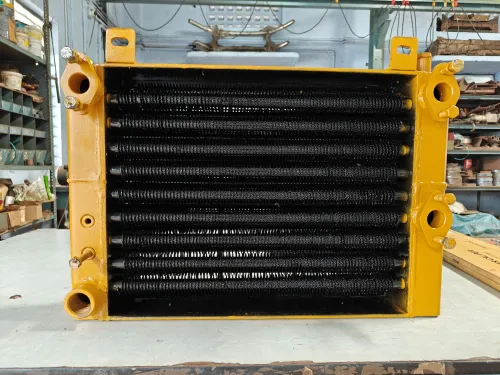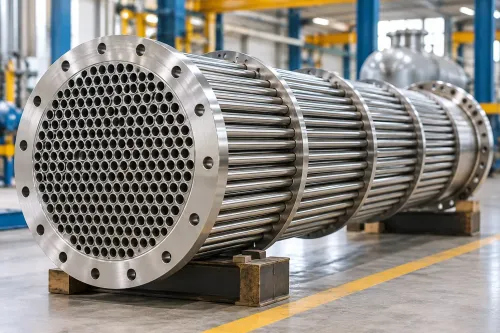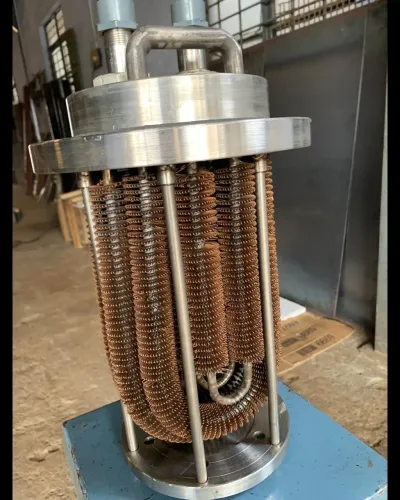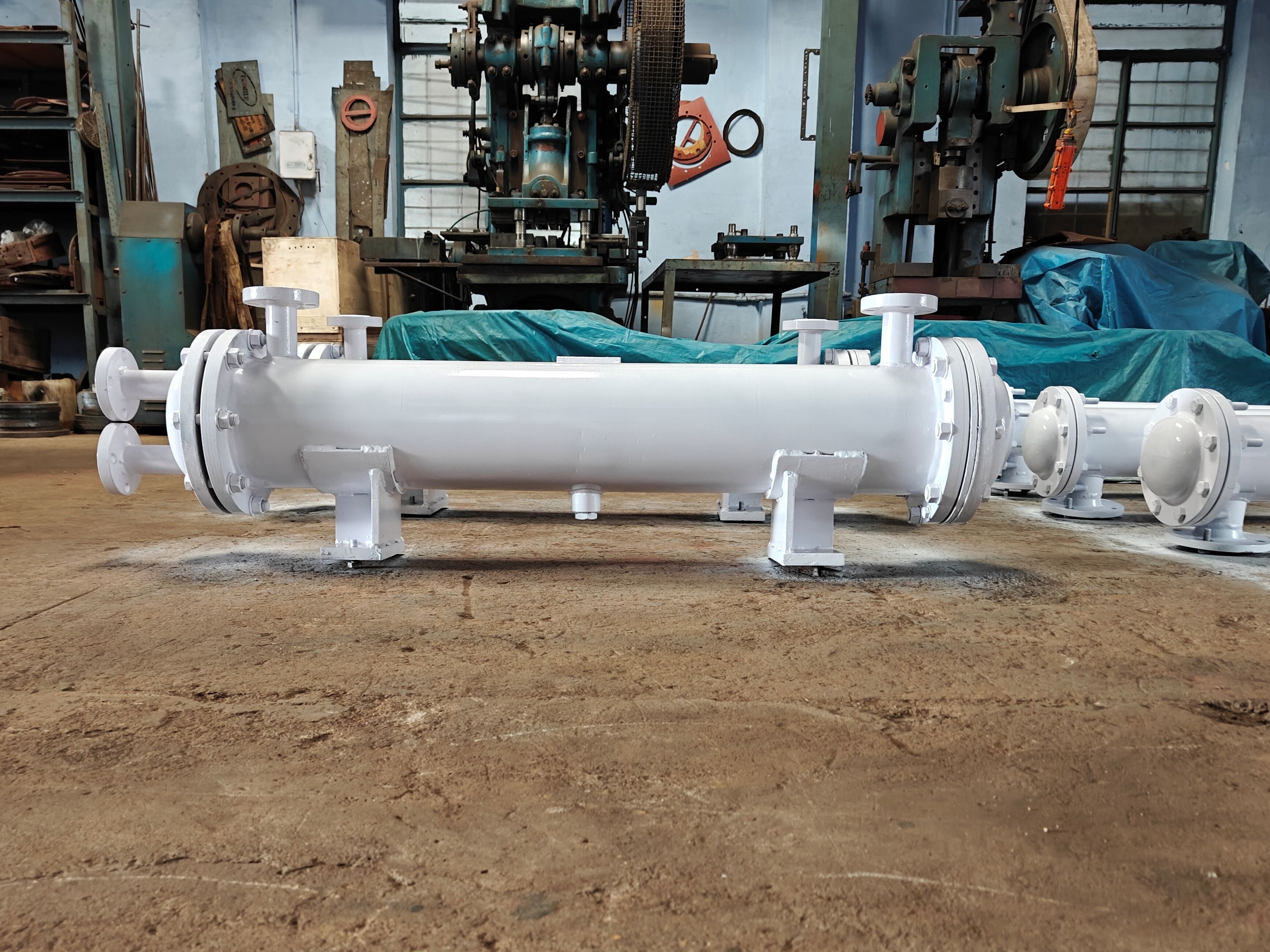
Hydraulic pumps, valves, actuators, motors, restrictions and pressure losses can turn a large share of input power into heat that accumulates in the oil reservoir. By the end, you will know how the exchanger removes that heat, how to measure the real cooling duty, and when water cooling is a better or worse choice than an air-blast cooler.
Key takeaways
- Measure oil temperature at the tank and return line before selecting a cooler.
- Specify oil flow, water flow, inlet temperatures, and target outlet temperature.
- Choose water cooling where space, noise, and steady heat rejection matter.
- Avoid water cooling when clean cooling water or corrosion control is unavailable.
How the oil-to-water exchanger removes heat without mixing fluids
A hydraulic oil-to-water heat exchanger removes heat through a metal wall: hot hydraulic oil travels through one circuit while cooling water travels through a separate circuit. Heat conducts across the wall, but the fluids remain separate. That is how an oil cooler works without diluting the oil or contaminating the water.
Counter-current flow usually gives a closer temperature approach than parallel flow for the same exchanger area. This matters when the desired oil outlet temperature is close to the cooling-water inlet temperature.
| Flow arrangement | Heat-transfer behaviour | Practical effect |
|---|---|---|
| Parallel flow | Oil and water enter at the same end and move together | The temperature difference falls quickly along the exchanger |
| Counter-current flow | Oil and water move in opposite directions | A closer outlet temperature approach and more usable cooling capacity |
The main hydraulic system heat sources are pump volumetric and mechanical inefficiency, proportional valves, servo valves, relief valves, undersized hoses and other restrictions. For a restriction, approximate heat release in kilowatts is pressure drop in bar × flow in litres per minute ÷ 600. Motors and actuators add heat through inefficiency, friction and overrunning loads.
That heat reaches the reservoir through return oil, pump case drains, valve leakage, actuator leakage and hot piping. The exchanger therefore controls the whole hydraulic circuit by rejecting heat entering the reservoir, rather than cooling an isolated oil volume.
How to measure whether your hydraulic system needs a cooler
A cooler is justified by the measured peak oil temperature and hydraulic heat load calculation, not by reservoir volume or pump horsepower. Perform the test during the heaviest credible duty cycle and record:
- Reservoir temperature measurement from a sensor placed where the oil is well mixed
- Hydraulic oil inlet and outlet temperature at the proposed cooler
- Oil flow in litres per minute, cooling-water inlet temperature and water flow
- Ambient temperature, machine cycle time and duration of high-load operation
- Pressure at major restrictions, including valves, hoses and other throttling points
Measure return oil from the heat-generating circuit when that stream is the condition you need to protect. An acceptable cooler outlet temperature can hide a hot pump case, bearing, valve manifold or poorly mixed reservoir.
Calculate heat released by pump and motor inefficiency, pressure losses, throttling, leakage and actuator overrunning. The actual heat load versus installed power matters: a high-horsepower pump running lightly can reject less heat than a smaller pump throttling heavily.
Cooler duty is only the fraction of that heat that must be removed to maintain the specified oil temperature.
| Measurement point | What it reveals | Main limitation |
|---|---|---|
| Reservoir | Bulk oil condition | Misses local hot spots |
| Cooler outlet | Exchanger performance | Cannot confirm reservoir or component safety |
| Return line | Heat entering the reservoir | Represents one circuit only |
Compare the measured peak with oil, seal, pump and valve limits before selecting capacity. Evaluate the worst combination of heat load, water temperature, reduced flow and partial fouling.
Which sizing inputs determine exchanger performance
Reservoir volume does not determine exchanger size: it only delays temperature rise. Hydraulic oil cooler sizing starts with the heat exchanger duty in kW and the operating conditions that let the supplier calculate area, flow velocity and temperature approach.
| Input | Give the supplier | Why it matters |
|---|---|---|
| Heat load | Required heat exchanger duty in kW | Sets the heat rejection capacity |
| Oil circuit | Hydraulic-oil flow in litres per minute | Determines oil-side velocity and heat transfer |
| Oil condition | Oil viscosity at operating temperature | Changes pressure drop and heat-transfer performance |
| Temperature target | Maximum target oil temperature | Defines the required cooling duty |
| Water circuit | Entering cooling-water temperature and available flow | Sets the practical temperature approach and water-side duty |
| Hydraulic limits | Allowable pressure drop on oil and water sides | Prevents starvation, bypassing and wasted pump power |
| Design condition | Worst credible ambient, summer water temperature, reduced flow and partial fouling | Prevents clean-catalog performance from overstating capacity |
The oil cannot leave colder than entering water temperature plus the exchanger’s required approach. With water entering at 30 °C, an oil target only a few degrees higher needs more exchanger area, more water flow or both; increasing oil flow alone cannot defeat that limit.
Check oil-side and water-side pressure ratings independently, including pressure spikes, thermal expansion and the consequence of an internal leak. Include cold-start viscosity in the control design: a thermostatic bypass or temperature-controlled water valve prevents thick oil from causing excessive pressure drop, seal damage or downstream starvation.
At low load, it also prevents overcooling, which raises viscosity and pressure loss.
When water cooling beats an air-blast oil cooler
Choose a water-cooled hydraulic oil cooler when floor space, heat rejection or hot ambient air makes fan cooling impractical. Water removes heat through a smaller exchanger, but only if the site provides dependable flow at a controlled temperature. Compare that against fan power, noise, airflow clearance and seasonal ambient conditions during air cooler selection.
| Option | Strength | Main penalty |
|---|---|---|
| Oil-to-water versus air-blast cooler | Compact size and stable heat rejection despite hot air | Requires treated water, filtration, freeze protection and water consumption |
| Air-blast cooler | No cooling-water circuit and simpler fluid separation | Needs fan power, noise control, airflow space and clean air passages |
| Return-line cooling | Compact installation using existing oil flow | Changing flow and pressure pulses can reduce predictable performance |
| Off-line cooling | Steady flow; can combine cooling with filtration | Adds a pump, motor power, controls and installation cost |
Select return-line cooling versus off-line cooling from the circuit behaviour, not footprint alone. A return-line unit suits a compact machine when flow and pressure remain within the exchanger limits; an off-line loop suits uneven demand or dirty oil that needs continuous filtration.
Size either arrangement for summer water temperature, reduced flow and partial fouling, then ask for pressure drop at the stated duty.
Premier Engineering Works can be included in a custom-machine comparison when the required water connection, pressure rating, flow arrangement or installation footprint does not match a catalogue unit. Ask every supplier to state tested heat duty, oil and water flow, inlet temperatures, fouled-condition performance and both-side pressure drop.
Related product
 | Equipment Cooling Premier Engineering Works offers a comprehensive range of oil coolers designed to effectively manage the temperature of low to high-viscosity... View product → |
When an oil-to-water exchanger is the wrong choice
Reject an oil-to-water exchanger when the site cannot supply treated water at adequate pressure, control its chemistry, or protect the circuit from freezing. Water quality must match the exchanger material, plate or tube passages, operating temperature and open or closed circuit.
Disqualifying conditions include:
- Severe scaling or uncontrolled suspended solids that create heat exchanger scaling and fouling
- Aggressive chemistry that attacks plates, tubes, brazing or gaskets
- Water pressure below the required flow after filters, valves and piping losses
- No filtration, treatment, velocity limits or access for cleaning
- A credible freezing risk without reliable heat tracing, draining or antifreeze protection
| Plate | Compact, high heat-transfer performance | Use clean, treated water with compatible gaskets, corrosion control and narrow-passage protection |
|---|---|---|
| Shell-and-tube | More space, but tubes are easier to mechanically clean | Consider for dirtier water or when hydraulic cooler maintenance requires tube access |
Treat internal leakage as a process failure, not only lost cooling. Water entering hydraulic oil can reduce lubricity, promote corrosion, deplete additives, plug filters and damage pumps or valves; oil entering plant water can contaminate that circuit. Use compatible construction, double walls or internal leak detection when either consequence is unacceptable.
Set the control band from the oil formulation, seal materials, component limits and cold-start viscosity requirements. Trend oil temperature, water and oil flow, differential pressure and bypass position; a rising pressure drop or falling duty exposes fouling, leakage or bypass failure before the reservoir overheats.
Frequently asked questions
How does an oil-to-water heat exchanger remove heat without mixing fluids?
Hot hydraulic oil and cooling water flow through separate passages divided by a metal wall. Heat conducts through the wall while the fluids remain separated.
How do you know whether a hydraulic system needs a cooler?
Measure reservoir, return-line, and ambient temperatures during the heaviest duty cycle. Compare the oil temperature with the hydraulic oil supplier’s maximum operating temperature and investigate rising temperature, sluggish operation, or frequent seal failures.
Which inputs determine hydraulic heat exchanger size?
Provide hydraulic oil flow rate, cooling-water flow rate, oil and water inlet temperatures, target oil outlet temperature, oil viscosity, allowable pressure drop, and the system’s heat load.
When does water cooling beat an air-blast oil cooler?
Water cooling is the stronger choice when you have reliable cooling water, limited installation space, strict noise limits, or a steady high heat load. It transfers heat efficiently without requiring a large fan and radiator.
When is an oil-to-water exchanger the wrong choice?
Avoid it when cooling water is unavailable, contaminated, corrosive, poorly filtered, or too warm to absorb the required heat. An air-blast cooler is better when water management and leak risk outweigh compactness.