A heater that reaches the required outlet temperature can still fail when the airflow basis is wrong, heat losses are omitted, or the fan cannot overcome system pressure drop. You will be able to convert the specified airflow into a defensible heat-duty calculation, select a suitable heating technology, and define the controls and safeguards needed for reliable operation.
Key takeaways
- Record inlet temperature, outlet temperature, airflow, pressure, and measurement locations.
- Calculate heat duty from actual airflow, then include duct, casing, and process losses.
- Match heater capacity with fan performance, recirculation, controls, and safety limits.
- Give suppliers operating conditions, fuel details, materials, controls, and required documents.
Define the Airflow and Temperature Conditions Before Choosing a Heater
A heater cannot be sized from a target temperature alone. Establish the process inlet temperature, required outlet temperature, actual airflow, operating pressure, and the location where each temperature is measured.
Record airflow as mass flow or actual volumetric flow at the heater inlet. Convert Nm³/h, standard m³/h, or SCFM using absolute pressure and absolute temperature; hot air expands, so standard-volume flow cannot be inserted directly into the duty calculation.
Confirm that the fan delivers this actual flow against the pressure drop of the heater, filters, dampers, ducting, silencers, and downstream equipment.
Specify temperature uniformity across the duct or chamber, not only the average sensor reading. State the maximum allowable temperature for the product and for local heater parts such as elements, sheaths, burner tiles, or heat-transfer surfaces.
Low airflow, blocked filters, closed dampers, and recirculation dead zones can overheat these parts while the outlet average appears correct.
| Temperature basis | What to define | Why it matters |
|---|---|---|
| Heater discharge air | Outlet sensor location and required outlet temperature | Controls heater duty but may not represent product temperature |
| Mixed air | Mixing point, recirculation ratio, and uniformity target | Poor mixing creates hot and cold zones |
| Product | Surface or core temperature and allowable limit | Product temperature can lag air temperature |
| Exhaust | Expected exhaust temperature and maximum allowable temperature | Reveals heat loss and downstream equipment limits |
Include cold start, shutdown, fan coast-down, damper closure, blocked-flow, and empty-duct conditions. Define independent high-temperature cutouts and safe shutdown actions before selecting capacity. For gas systems, also state the low-load requirement so burner minimum output does not cause cycling or temperature overshoot.
Calculate Heat Duty from Actual Airflow, Then Add Process Losses
Convert airflow to mass flow at the heater inlet, then apply Q = ṁ × Cp × ΔT. The result is heater duty in kW when ṁ is in kg/s, Cp in kJ/kg·K, and ΔT in °C or K.
1. Establish the actual inlet volume. If the specification gives m³/h measured at heater-inlet conditions, divide by 3,600 to obtain m³/s. For Nm³/h or SCFM, convert standard volume to actual volume using:
Vactual = Vstandard × (Tactual ÷ Tstandard) × (Pstandard ÷ Pactual)
Use absolute temperature in kelvins and absolute pressure. Hot air occupies more volume, so using Nm³/h directly can understate the required fan flow and distort heater sizing. The same conversion applies to SCFM to actual airflow conversion.
2. Convert m³/h to mass flow. Multiply actual m³/s by air density at the inlet condition. For dry air, use the density from the operating pressure and temperature rather than a fixed sea-level value.
3. Calculate sensible duty. For example, 2,000 m³/h at 1.10 kg/m³ gives 0.611 kg/s. Raising air from 30°C to 150°C gives Q = 0.611 × 1.005 × 120 = 73.9 kW.
4. Add duct, casing, radiation, leakage, and process losses. With 8 kW of measured or estimated losses, the required input is 81.9 kW; specify about 82 kW, subject to the supplier’s standard rating. Use an enthalpy balance when moisture evaporates or condenses.
Choose the Heating Technology and Combustion Arrangement
Choose the heater by three constraints: available utility, what may enter the airstream, and how quickly the load changes. An electric resistance heater provides clean air and fast, precise response, but its electrical demand can be substantial. A steam air heater offers stable, responsive heating when steam and condensate return are available.
A thermal-oil heater suits high, steady temperatures with an existing hot-oil loop, but stored heat slows shutdown and low-load response.
| Technology | Air entering process | Best fit | Main limitation |
|---|---|---|---|
| Electric resistance heater | No combustion products | Clean products, tight temperature control, rapid changes | High electrical load |
| Gas-fired air heater, direct-fired | Combustion products enter air | High-temperature service where added moisture and gases are acceptable | Adds water vapour, carbon dioxide, and contaminants |
| Gas-fired air heater, indirect-fired | Combustion stays outside process air | Sensitive products or clean-air requirements | Heat-exchanger cost and temperature loss |
| Steam air heater | Steam-side heat crosses a coil | Existing steam system and moderate response demands | Coil leakage can contaminate air |
| Thermal-oil heater | Oil-side heat crosses a coil | High-temperature, steady-duty processes | Slow thermal response and pump-loop complexity |
Direct-fired gas equipment needs burner turndown matched to the low-load duty. If minimum output is too high, cycling, overshoot, and repeated purge sequences follow; staged firing, wider turndown, a bypass, or electric trim can work better than oversizing.
For solvents, combustible dust, or flammable vapours, review purge, flame supervision, fuel shutoff, ventilation, and electrical classification against the installation standard.
Recirculation reduces duty by heating only makeup air, but contaminant control must address solvent vapour, corrosives, moisture, dust, and product volatiles. Define whether temperature means discharge air, mixed air, product surface, product core, or exhaust; product temperature can lag air temperature.
Match Heater Capacity to Fans, Recirculation, Controls, and Safety Limits
Size the fan and heater as one system. Nominal fan capacity proves nothing if the fan cannot deliver the required actual airflow at the combined pressure drop of the heater and connected equipment. Low airflow can trip the high-limit device, damage elements, and create severe outlet temperature stratification.
Specify both design airflow and minimum permissible airflow. Tie the minimum to the heater surface-temperature limit, then verify it with an airflow-proving switch, differential-pressure device, or fan-status interlock. A temperature controller alone cannot reliably detect lost airflow.
Operating mode changes the control strategy. Continuous airflow needs stable modulation across the normal production range, while batch operation needs controlled ramp-up, soak, cooldown, and a restart sequence. Use a modulating gas valve, SCR power controller, or staged elements when load changes would otherwise cause repeated high-limit trips.
A high recirculation ratio reduces energy use because the heater raises the temperature of only the replacement air. Set the fresh-air percentage from contaminant limits, not energy targets: solvent vapour, corrosive compounds, moisture, combustible dust, and product volatiles require purge, filtration, or exhaust provisions before recirculation.
For combustible atmospheres, treat selection as a process-safety review. Confirm these functions against the applicable installation standard:
- Ignition-source control and electrical classification
- Purge-cycle timing and ventilation
- Flame supervision and automatic fuel shutoff
- Independent high-temperature protection
- Interlocks for fan failure, low airflow, and unsafe damper position
Measure the controlled temperature where it matters. Product temperature can lag discharge air, so a heater sized only to an air setpoint can undershoot throughput or waste energy through oversizing.
Turn the Calculation into a Supplier Specification
A fair request for quotation starts with operating points, not a heater kW figure. Give suppliers the same inlet conditions and require each proposal to show duty, outlet performance, pressure loss, controls, and protection at those points.
- Normal and minimum permissible airflow at the heater inlet, in actual m³/h or kg/h, plus the conversion basis for any Nm³/h or SCFM value.
- Fan operating point: airflow at the combined system pressure drop through the heater core, burner, filters, dampers, ducting, silencers, and downstream equipment. State the available fan pressure drop.
- Inlet temperature, target temperature, and maximum permissible temperature, with each measurement location identified as discharge air, mixed air, product surface, product core, or exhaust.
- Required temperature uniformity, stated as a tolerance across the duct or chamber, and the permitted ramp time.
- Energy source, direct- or indirect-fired arrangement, materials, electrical supply, and control signal.
- Startup, shutdown, fan coast-down, blocked-flow, damper-closed, and empty-duct ratings, including an independent high-temperature cutout and safe shutdown sequence.
Require the supplier to verify the minimum-flow limit against element or heat-exchanger surface temperature. The protection method must be named: airflow-proving switch, differential-pressure device, or fan-status interlock; a temperature controller alone cannot prove flow.
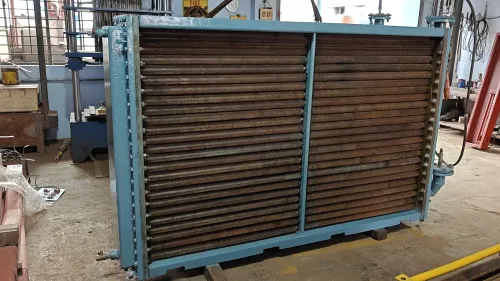
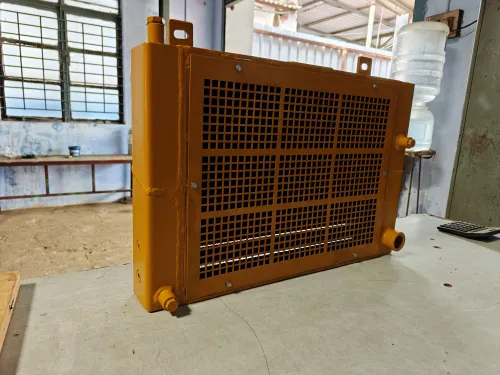
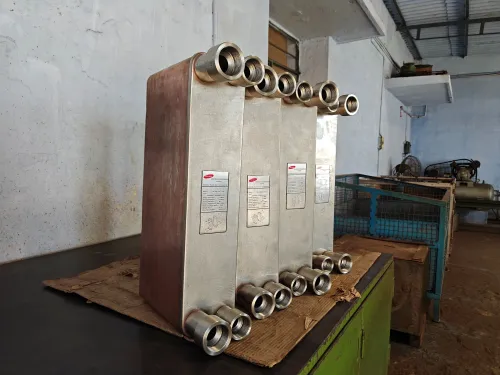
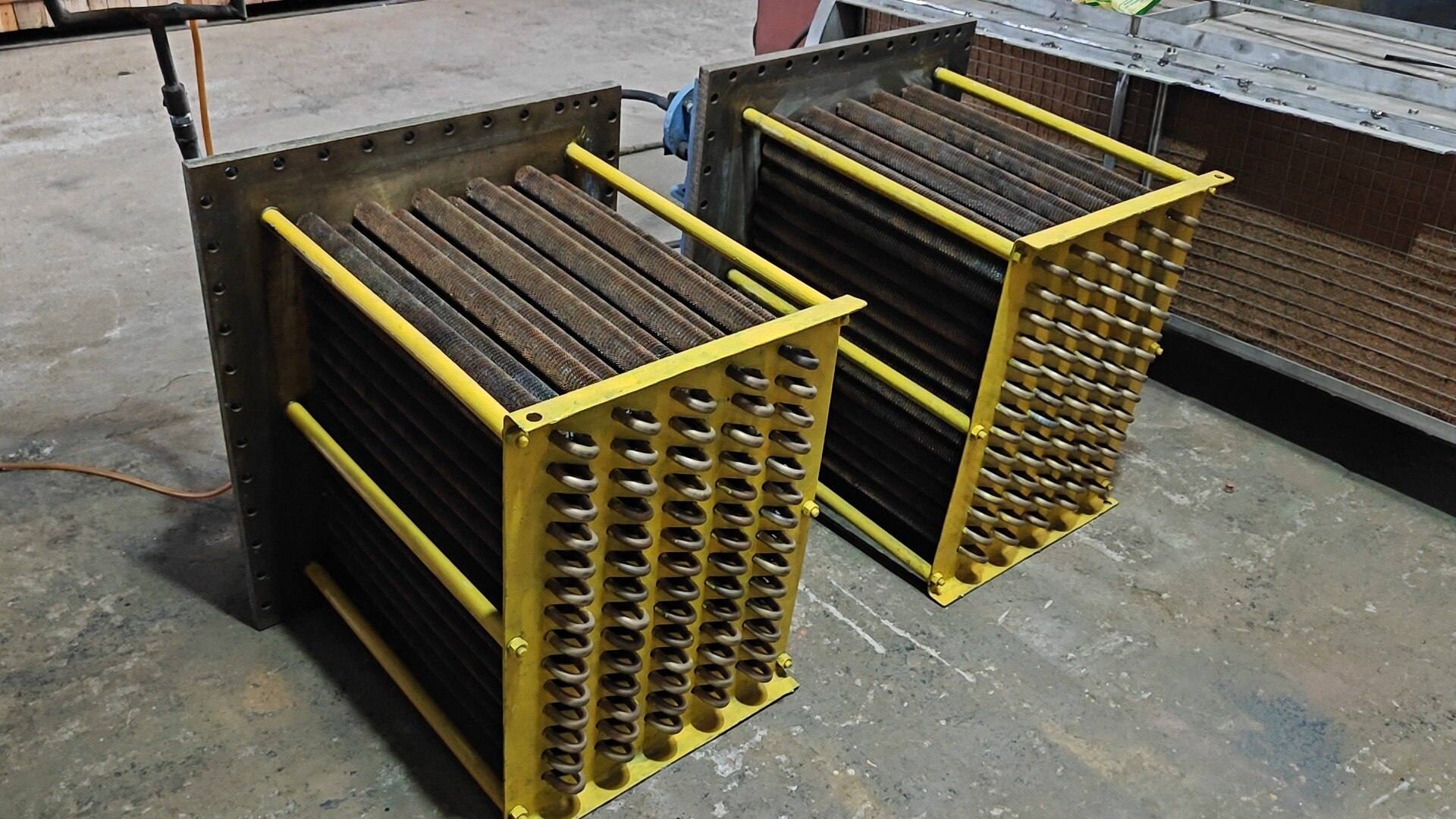
Ask for a fan curve or test point, heater pressure-drop data, temperature maps, and alarm setpoints. Premier Engineering Works can help evaluate an indirect heat-exchanger design when those figures are presented alongside the process duty, rather than as a standalone capacity claim.
Frequently asked questions
What conditions must you define before selecting an industrial air heater?
Define process inlet temperature, required outlet temperature, actual airflow, operating pressure, and the location of each temperature measurement.
How do you calculate industrial air heater heat duty?
Use actual airflow and the required temperature rise, then add heat losses from ducts, casing, leakage, exhaust, and the process.
How do you choose between industrial air-heating technologies?
Compare electric, direct-fired, and indirect-fired heating against process temperature, air cleanliness, fuel availability, efficiency, combustion arrangement, and exhaust requirements.
What should an industrial air heater supplier specification include?
State airflow, pressure, inlet and outlet temperatures, heat duty, fuel or electrical supply, materials, controls, safety limits, fan data, recirculation, and testing documents.