A boiler loses valuable energy when hot flue gas leaves the stack, but recovering that heat is only worthwhile if the exchanger avoids acid condensation, excessive pressure drop, fouling and burner-control problems. By the end, you will be able to estimate the recoverable heat, compare preheater types, check operating limits and identify the design and maintenance features that protect the efficiency gain.
Key takeaways
- Use a heat balance to estimate recovered heat and fuel savings.
- Keep metal temperatures above the flue-gas acid dew point.
- Check leakage, pressure drop, fouling allowance, and cold-end corrosion protection.
- Approve designs against measured gas flow, temperatures, composition, and operating load.
How does a boiler air preheater transfer heat to combustion air?
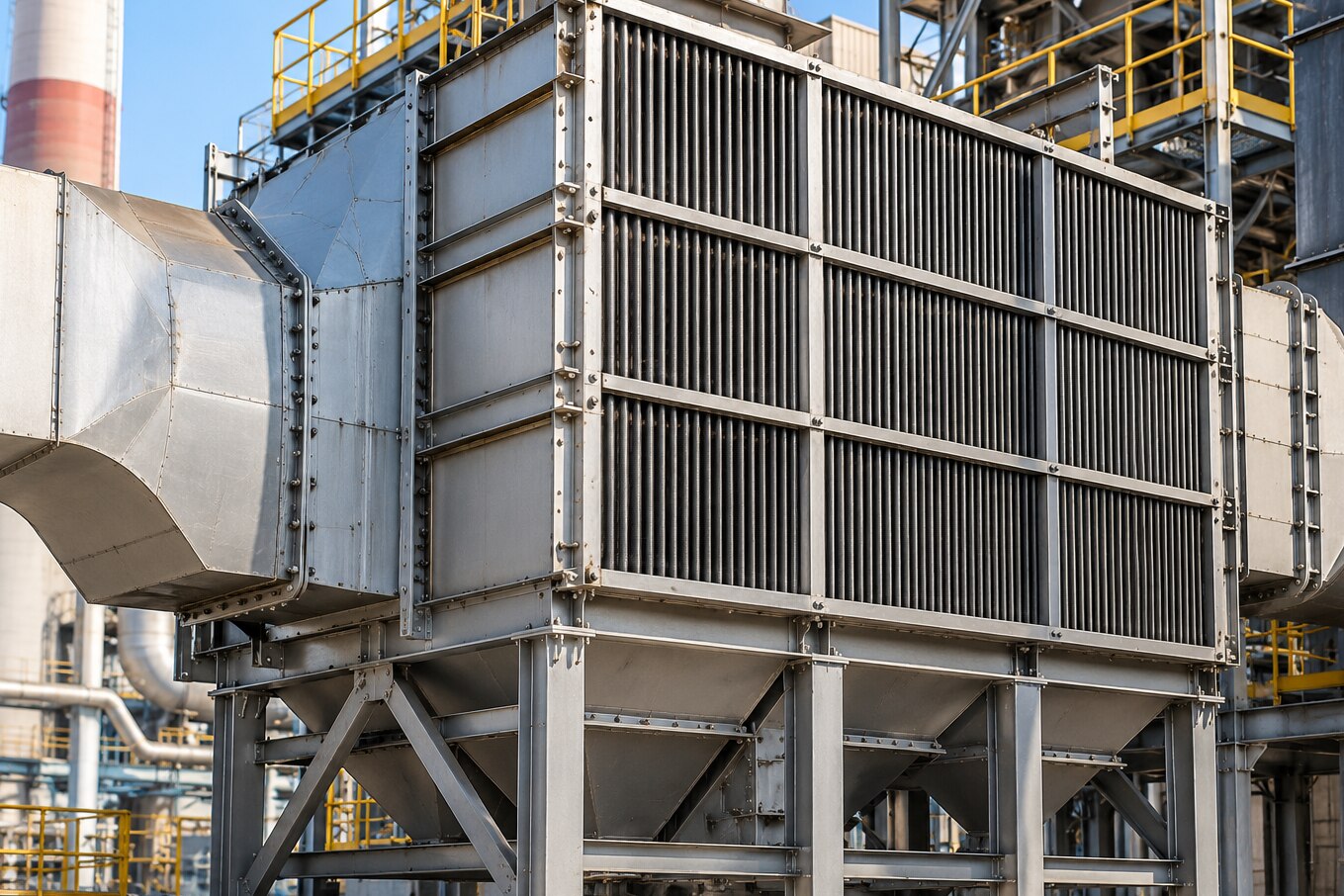
Hot flue gas leaving the furnace gives up sensible heat as it passes through one side of a boiler air preheater, while ambient air from the forced-draft fan moves through the other. The streams remain separate, but heat crosses the metal surface into the combustion air.
| Type | Heat-transfer method | Typical location |
|---|---|---|
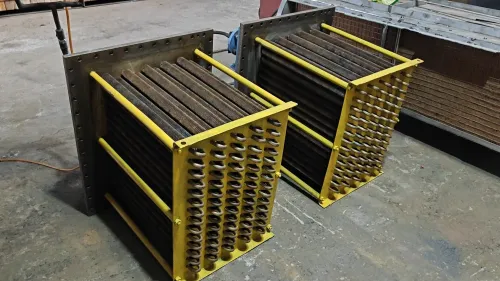
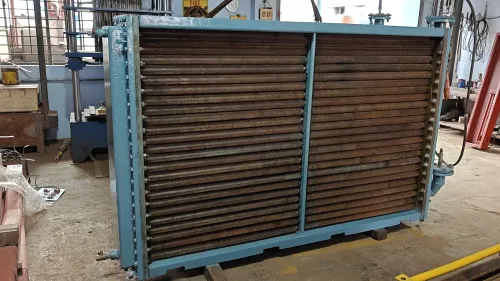
| Recuperative air preheater | Fixed stainless steel tubes or plates separate flue gas and air continuously | Boiler back end |
| Ljungström regenerative air preheater | A rotating basket absorbs heat from flue gas, then releases it to air | Large utility boilers |
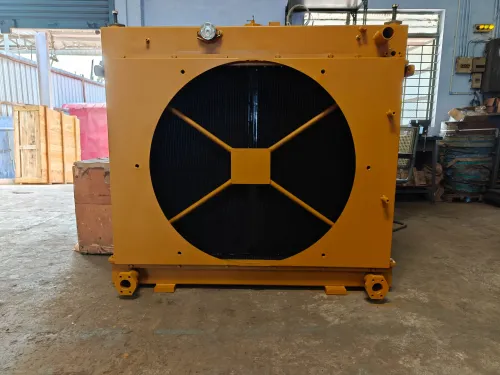
| Combustion-air recuperator | Compact gas-to-air exchanger transfers heat near the burner or furnace | Burner or furnace area |
The hotter incoming air improves combustion and raises flame temperature, so the boiler needs less fuel for the same steam output. The trade-off is higher thermal NOx formation if flame temperature rises beyond the burner’s control range.
Check these operating effects in a rotary unit:
- Air-to-gas leakage adds oxygen to outlet flue gas and dilutes its measured constituents.
- Extra leaked air increases forced-draft and induced-draft fan flow, raising power use.
- Leakage can make the excess-air reading look high even when furnace air control is correct.
Seals, baskets, plates, and tubes therefore affect both recovered heat and the accuracy of combustion diagnosis.
How much heat and fuel can the preheater recover?
A practical heat balance estimates recoverable heat from both streams with Q = m × Cp × ΔT.
Gather these measurements:
- Flue-gas mass flow and combustion-air mass flow
- Flue-gas inlet and outlet temperatures
- Air inlet and outlet temperatures
- Specific heat of each stream
| Stream | Calculation | Heat rate |
|---|---|---|
| Flue gas | 10,000 kg/h × 1.05 kJ/kg-K × (180−130 K) | 525,000 kJ/h, or about 146 kW released |
| Combustion air | 9,000 kg/h × 1.01 kJ/kg-K × (80−30 K) | 454,500 kJ/h received |
The difference, about 70,500 kJ/h, represents heat loss, leakage and measurement uncertainty. It is not automatically recoverable heat.
A lower stack-gas temperature alone does not prove higher boiler efficiency. Correct the comparison using flue-gas oxygen or carbon dioxide, carbon monoxide, fuel composition, steam output and feedwater conditions; air leakage can raise measured oxygen without indicating excessive furnace air.
Relate the recovered heat to fuel input and fuel heating value. At constant steam output, reduced stack loss and hotter combustion air can lower fuel consumption, but Q does not convert directly into fuel savings because exchanger losses, radiation and combustion losses remain.
The benefit disappears when excess air is uncontrolled: extra air carries heat up the stack, while leakage increases gas volume and fan power. Compare boiler efficiency before and after at matched load, fuel, steam production, feedwater temperature, oxygen level and combustion-air temperature.
Which preheater limits determine whether the boiler can use it?
Start with a fit-check, not a catalogue rating. Confirm the design flue-gas flow, combustion-air flow, inlet temperatures, target outlet temperatures, maximum metal temperature, allowable gas-side pressure drop and allowable air-side pressure drop.
Check these values at the conditions that define the boiler’s envelope:
- Full load and minimum stable load
- Startup and low-load operation
- Each planned fuel, including fuel switching and high-moisture fuel
- Excess-air range and ambient-air temperature
- Acid-dew-point and water-dew-point margins
An economizer and air preheater compete for the same flue-gas temperature potential. The economizer heats feedwater; the air preheater heats combustion air.
| Option | Heat recipient | Main constraint |
|---|---|---|
| Economizer | Feedwater | Feedwater temperature and allowable stack temperature |
| Air preheater | Combustion air | Burner air-temperature limit and fan capacity |
Compare the recovered fuel value with the extra forced-draft and induced-draft fan power caused by added pressure drop. A lower stack temperature is not a gain if the fans lack capacity or their electricity use consumes the saving.
Provide a bypass damper or tempering arrangement when gas temperature or flow falls below the clean operating range, including startup, low load and wet-fuel operation. Tempering also protects burners from excessive air temperature and unstable combustion.
A nameplate air-preheat temperature is not a guaranteed field result; fouling, leakage, load, excess air and fuel moisture change the delivered temperature.
How do you prevent acid-dew-point corrosion and fouling?
Keep the cold-end metal temperature above the calculated acid dew point by a documented margin. Sulfur in fuel can form sulfur trioxide, which combines with water vapour on cooler metal to produce sulfuric acid condensation and acid-dew-point corrosion.
The actual dew point depends on fuel sulfur, sulfur-trioxide formation, moisture and flue-gas composition, so do not chase the lowest outlet-gas temperature.
Ordinary water condensation is a separate risk. Both water and acid condensation cause corrosion, deposits and plugging, but they require different operating and drainage controls.
| Fuel | Main fouling risk | Design response |
|---|---|---|
| coal boiler | Fly ash and unburned carbon | Larger passages, suitable gas velocity and effective sootblowers |
| biomass boiler | Ash and sticky alkali-rich deposits | Online cleaning, washing provisions and generous access |
| oil-fired boiler | Soot and sulfur-related deposits | Soot blowing, wash capability and close cold-end monitoring |
| gas-fired boiler | Less particulate fouling, but corrosion or debris can still occur | Inspection and drain provisions; do not eliminate routine checks |
Match passage size and gas velocity to the fuel’s ash behaviour. Provide soot blowing, online cleaning, water-washing provisions, inspection doors, drain points, and isolation or bypass dampers. A bypass or tempering arrangement protects the exchanger during startup, low load and fuel switching, when gas temperature can fall below the clean operating range.
Require physical access to baskets, tubes and seals; inaccessible surfaces turn routine cleaning into an outage.
What should you verify before approving an air-preheater design?
Approve the design only when its duty, controls, maintenance access and test method are documented. Use this air-preheater selection checklist:
1. Request heat-balance calculations at design load, minimum load and the expected fuel range. Require stated assumptions for excess air, ambient temperature, fuel moisture, sulfur content and fouling condition.
2. Obtain pressure-drop curves for both gas and air, plus predicted regenerative-preheater leakage. Check the leakage effect on oxygen readings, fan capacity and induced-draft margin.
3. Confirm the burner’s maximum permitted air temperature. Require a control narrative covering bypass, tempering, startup and low-load protection so cold-end condensation and unstable firing do not become operating failures.
4. Ask how operators will perform sootblowing, water washing, drain-down and inspection. Require access for replacing seals, baskets, tubes or other heat-transfer surfaces without dismantling unrelated boiler equipment.
5. Define a performance acceptance test under corrected operating conditions using ASME PTC 4. Account for energy input, steam output, stack and radiation losses, and measurement uncertainty. Reject a single outlet-temperature reading as proof of efficiency.
For a boiler retrofit, Premier Engineering Works can help compare custom heat-transfer equipment against boiler flow, temperature, pressure-drop, access and corrosion constraints. Compare documented duty and maintainability, including regenerative preheater leakage, rather than a generic efficiency claim.
Frequently asked questions
How does a boiler air preheater transfer heat to combustion air?
Hot flue gas flows through tubes, plates, or rotating heating elements while forced-draft air flows through separate passages. Heat crosses the metal surface without mixing the two streams.
How much heat and fuel can a boiler air preheater recover?
Estimate recovered heat with Q = m × Cp × ΔT for the air stream, then compare that duty with the fuel input. Fuel savings depend on boiler efficiency, excess air, air temperature rise, load, and flue-gas losses.
Which preheater limits determine whether the boiler can use it?
Check air and gas flow capacity, allowable pressure drop, heat-transfer area, leakage, outlet-air temperature, material limits, fan margin, and the required turndown range.
How do you prevent acid-dew-point corrosion and fouling?
Keep cold-end metal temperatures above the acid dew point, control sulfur and moisture in the fuel, prevent air ingress, provide sootblowing or washing access, and inspect deposits and drains.
What should you verify before approving an air-preheater design?
Verify design fuel, gas composition, inlet and outlet temperatures, mass flows, heat duty, pressure drops, corrosion allowance, cleaning provisions, leakage limits, materials, controls, and performance-test conditions.